Wednesday, June 2, 2010

FERIA CHICA DE LOJA


This weekend, 3-6 June, is the Feria Chica de Loja. A fairground has been set up in the town but it is not as large as the Feria in Huétor Tája two weeks ago as the main Fiesta in Loja is at the end of August. On Friday night, though, we went to a special event "Aires de Raza Flamenco" in the football ground of the Barrio San Antonio.
The show began with two dancers and two horses, ridden by men in striking costume, performing a carefully choreographed dance in which the movements of the flamenco dancers complemented the actions of the horses. Two different horses, equally magnificent, performed a graceful ballet around long poles carried by their riders.
On the stadium, first class singers, guitarists and a flautist performed throughout theshow. Also on stage, two exceptionally good dancers gave a thrilling display. This was authentic flamenco, very different from the flamenco shows put on for the entertainment of tourists.
The performance ended, as it had begun, with dancers and horses. It was a wonderful show, enjoyed by everyone. Afterwards, we made our way home, stopping enroute at our nearest village, La Fábrica, for supper. Although it was past midnight, the terrace outside the bar was filled with villagers.
Unfortunately our compact digital camera was not able to capture images of the show so we would like to thank our friends Jim and Denise for these photos taken by them with their SLR.
During the summer months, the balmy evenings bring the people of Loja outdoors to fill the street cafés and pleasant, leafy squares which, at this time of year, saturate the whole town with the heady scent of lime blossom. We ourselves enjoyed a stroll around the lower part of the town and came upon a delightful square, canopied with trees, where we stopped for drinks and tapas before heading to the arena to watch theflamenco display.

Sunday, May 16, 2010

FIESTAS IN HUÉTOR TÁJAR


Since Thursday Huétor Tájar has been celebrating its May feria and fiestas in honour of San Isidro Labrador (there always has to be a saintly excuse). At the Nuevo Recinta Ferial, a vast area on the edge of town reserved for fiestas and markets, a huge fairground has appeared and numerous large marquees have been erected, housing bars with kitchens to feed and water the multitude. Most of these have stages so that live music can be played all night.

On Saturday morning there was a Romeria (pilgrimage) through the town ending up at the fairground where, in the Town Hall’s marquee, paella and beer was provided for all. In the evening there was a horse fair and handsome young men arrived proudly riding their beautiful Andalucian horses. Others came in immaculately turned out horse drawn carriages.

The festivities go on all night but today, when we visited again at lunchtime, there were more children around and the fairground rides were busy while the adults were propping up the bars enjoying cerveza y pinchos (beer and kebabs). Tonight, after a mass in honour of San Isidro, there will be a firework display in the Plaza de Andalucia and then everyone will go back to the fairground to party all night once again. Not surprisingly tomorrow is a public holiday in Huétor Tájar and all the shops will be closed.

Despite the economic crisis and dire warnings from the EU about Spain’s financial situation, this country still seems hell bent on enjoying itself and spending money.

Monday, May 3, 2010

DIA DE LA CRUZ


On the 3rd of May, Dia de la Cruz (Day of the Cross) is celebrated in many towns and villages in Andalucia. In Loja The children of the town created decorative crosses and gather in the Plaza de la Constitucion. They then carry their crosses through the Town collecting money for charity and end up in the Peña de Flamenca for a drink and sandwich. This is another noisy and colourful event typical of Southern Spain.

Sunday, May 2, 2010

SUNDAY AT RIO FRIO


Rio Frio, just off the A92 west of Loja, is famous for its trout hatcheries and clear river waters. On Sundays it is a popular outing for people from Loja who come to stroll along the riverside paths, visit the little craft market and enjoy lunch, particularly fresh trout in one of the many restaurants. Our grand daughters enjoyed the outing but Izzy lost a sandal when she paddled at the edge of the fast flowing river. Digby rushed downstream along the side of the river to where the sandal had got trapped in reeds on the opposite bank. He rolled up his jeans and waded across to retrieve the sandal. The incident proved amusing to the onlookers. One old boy remarked to Digby as he held out his walking stick to help Digby get out of the river “Now you know why it’s called Rio Frio” (Cold River).

Saturday, May 1, 2010

ROMERIA DE AMISTAD


Today, 1st May, Loja celebrates the Romeria de Amistad, Pilgrimage of Friendship, in the fields of Venta de Rayo. This is a pretty spot backed by the Sierra de Loja and looking towards the olive hills by the Lake of Iznajar. There are some good walking routes from here which we must try out later. When we arrived this morning many people, who had presumably arrived last night, had already set up camp and were enjoying picnics in the sunshine.
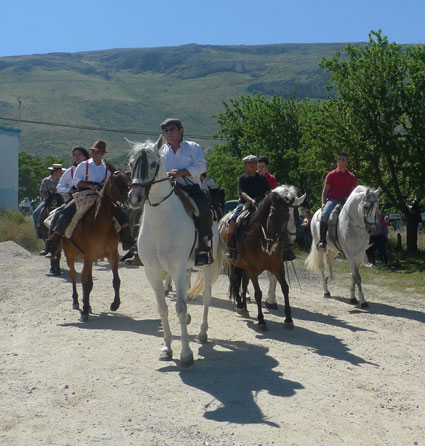
Soon most of the town seemed to turn up in a procession of brightly coloured floats blasting out traditional Spanish Sevillana music, or on horseback.
Although there were temporary bars set up on the site most of the public came well stocked with food and drink. Soon the umbtrellas and tables were erected by the parked floats and the crowd set about enjoying themselves. It has been a beautiful day and the occasion was full of colour. No doubt the festivities will continue late into the night when there will be live music to entertain the gathering.

Thursday, April 15, 2010

A GASTRONOMIC FESTIVAL


To celebrate the asparagus harvest our local hotel, Cortijo de Tajar, is holding a gastronomic weekend. Its restaurant, which is regarded as one of the best in the area, is offering 3 course dinners with 3 choices per course. Every dish includes locally grown asparagus and produce from the area. For example, one first course is crunchy cakes of langostine and green asparagus; a second course is lamb from the Sierra de Loja stuffed with asparagus and a pudding course is vanilla ice cream with asparagus marmalade. The cost is €32 per head but includes an aperitif, wines from the region, liquors and coffee.

At midday on Friday, Saturday and Sunday the hotel is offering a tasting of local wines, cheeses and tapas. For information about the hotel have a look at their web site www.cortijodetajar.es.

Today, Saturday, we attended the wine and tapas tasting. The wines were from the Bodegas Pago de Almaraes in the north west of Granada. Their white, elaboarated mainly with Muscatel grapes was superb and has won a gold medal. We shall visit the vineyard later and report in more detail. www.bodegaspagodealmaraes.es

Also on display for sampling were the vegetable marmalades from Casa Rufino, Huétor Tájar. The marmalades are produced from asparagus, artichokes, red peppers, beetroot and tomatoes. www.mermeladascasarufino.com.
We were also served with the most delicious tapas prepared in the hotel’s kitchen.

Friday, April 2, 2010

VIERNES SANTO


Viernes Santo, Good Friday, is the most holy day in the Spanish Catholic calendar. All towns and villages have their processions during Semana Santa, Holy Week, but in Loja the Easter processions are amongst the most significant in Andalucia.

This morning the most important procession of the week started from the Ermita de Jesús and followed the narrow streets of the old town to the main church of Santa Maria de la Encarnación. Semana Santa in Loja is distinguished by its famous “Incensarios” ( incense carriers ) - groups of eight men who, in reverence to the images, perform an extraordinary dance comprising graceful curtseys punctuated by stampings. Their elegant costumes, one group in white and others in black, are crowned by tall, conical, richly beaded hats. The waving of incense is accompanied by haunting songs, very Arabic in influence, demonstrating the fascinating mix of Islam and Christianity which is so typical of this part of Spain.

The statue of Santa Marcela, which led the procession, was followed by the statue of Jesús carrying his cross, accompanied by Roman centurions resplendent in purple and gold. The images of the saints were followed by drummers, a band, penitents with covered faces and tall, black, conical hats and others from the participating “hermanidads”. The Virgen de la Angustias, adorned with white flowers, was the final image to be paraded.

The procession, which lasts all day, makes a circular tour of the town and we watched it from the main church and the Plaza Constitución. Although a solemn occasion, it was a quite spectacular event and full of colour beneath a cloudless blue sky.